 Sorare
Sorare auctions bidding limits and new card sale prices
Sorare auctions sell newly issued digital player cards through timed bidding, with the highest accepted bid determining the sale price. Buyers can enter bids manually or set a maximum that lets automatic bidding respond to competitors. That maximum authorizes further bids up to a ceiling; it does not mean every winner pays the ceiling. Eligible Discount Credits may reduce the buyer’s payment, while funding charges can add separate costs outside the auction price.
The short version: Stopping automatic bidding prevents further responses, but your existing bid can still win the card.
New Card Issuance and Price Discovery
New card auctions connect first issuance with competitive price setting, allowing buyers to acquire cards directly from Sorare. Each listing identifies the card on offer and the period during which bidding remains open. Buyers compete for that specific listing, so the leading amount describes demand for one auction. It does not establish a fixed price for every card depicting the player.
The card’s season and scarcity identify important differences between copies. A player name alone cannot distinguish those editions. These details also explain why another auction or an existing owner’s listing may show a different amount. Comparing equivalent cards gives the bidding price more context without treating a previous sale as a promise.
Card and Payment Readiness
Bid preparation covers the exact card, the payment method and sufficient funds for the amount being committed. Payment availability and card suitability are separate questions.
Card Details
The auction listing identifies the player card that the winning bidder will acquire. Check the sport, season, scarcity and any edition details before committing money. A familiar player photograph can appear on different cards. Card rarities describe supply categories, while the auction identifies the particular item for sale.
Wallet or Bank Card
The bid dialog determines which payment methods are available for the purchase. Cash Wallet, cryptocurrency wallet and bank-card payment are distinct routes where offered. A wallet-funded bid requires sufficient available funds. Cash Wallet funding also requires identity verification, and bank-card payments may require additional bank authentication. A pending deposit has not yet become an available wallet balance. An approaching auction deadline does not remove that funding prerequisite.
Accepted Bids and Card Delivery
An accepted bid establishes a position in a live auction; card delivery follows a completed purchase after bidding closes.
The auction record distinguishes its current price, leading bidder and end time. A minimum next bid also controls whether a new amount can enter the competition. An amount typed into a payment window does not establish a recorded bid. Any error or unfinished bank authentication needs resolution before treating the submission as successful.
The highest bidder at the end acquires the card. Being ahead earlier gives no permanent claim, because another accepted bid can change the lead before closing. Automatic bidding follows the same auction outcome rule.
An auction win can precede the card’s appearance in your gallery. Settlement can occasionally delay delivery. Payment authorization alone cannot confirm card ownership, and an auction screenshot taken before closing cannot confirm a win.
A missing card after a confirmed purchase calls for checking the transaction record and delivery status. Keep the exact card and auction details available when contacting support about a persistent delay.
Maximum Bids and Automatic Responses
A maximum bid gives the bidding system permission to answer competing bids until it reaches your chosen ceiling.
Entry Amounts
The first bid must meet the auction’s starting price. Once bidding begins, a newly submitted bid must meet the minimum increment above the current leading amount. Use the minimum next bid shown for that listing, because the applicable increment governs acceptance. Different increments can apply to a newly entered bid and an existing automated response. A small automated increase therefore does not establish what a new manual bidder can submit.
Ceiling and Competition
Automatic bidding submits responses on your behalf up to the maximum you set. Competing bids determine how far the accepted price rises within that authorization. A winning amount can finish below the ceiling when competition stops earlier. If the next permissible response exceeds your limit, automation cannot keep you ahead. Increasing the maximum expands the amount that the system can commit; it does not guarantee a win.
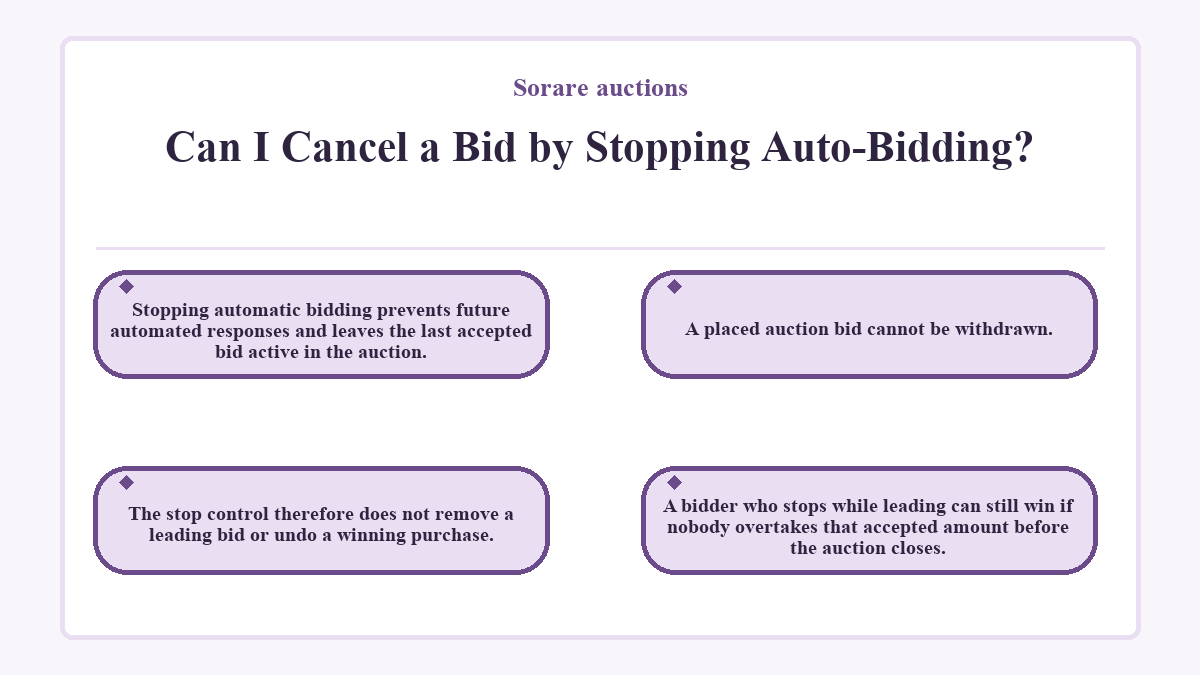
Can I Cancel a Bid by Stopping Auto-Bidding?
Stopping automatic bidding prevents future automated responses and leaves the last accepted bid active in the auction. A placed auction bid cannot be withdrawn. The stop control therefore does not remove a leading bid or undo a winning purchase. A bidder who stops while leading can still win if nobody overtakes that accepted amount before the auction closes.
Discount Credits and Payment Costs
Discount Credits reduce eligible Primary Market purchases, including auctions, under the terms of the particular credit programme. Discount Credits cannot be used for Manager Sales or Direct Offers. Each credit applies to one sport; eligible scarcities and players depend on the programme. The programme specifies its discount, expiry and any minimum spend or usage cap. Expired credits cannot be used; a purchase below a stated minimum receives no credit discount. A credit balance is a purchase discount, not a cash balance that can be withdrawn.
Funding costs sit outside auction competition. Cash deposits, bank-card funding and external cryptocurrency transfers can carry different charges. An eligible credit reduces the purchase payment, while a funding charge affects the cost of supplying that money. The same bid amount can therefore have a different total payment cost through another funding method.
Bidding Methods and Funding Constraints
Bidding methods control price escalation, while funding methods control payment; Discount Credits reduce eligible purchases under separate programme conditions. These options can combine, so an automated bid still needs a compatible payment method.
| Auction Option | What It Changes | Main Purchase Constraint |
|---|---|---|
| Manual bid | Enters an amount chosen by the bidder | A later accepted bid can overtake it |
| Automatic bidding | Responds to competitors within a chosen ceiling | The next response cannot exceed the maximum |
| Cash Wallet | Pays from an available cash balance | Insufficient available cash prevents wallet-funded payment |
| Cryptocurrency wallet | Uses a supported cryptocurrency balance | The currency and payment route must match the available configuration |
| Bank card | Provides a direct card-payment route where offered | Issuer refusal or unfinished authentication can block payment |
| Discount Credits | Reduce the amount due on an eligible purchase | Card eligibility, expiry and programme limits govern use |
| Combined options | Compatible choices can serve one purchase | Funding and credit conditions still apply |
Auction Closing and Alternative Sale Terms
Sorare can extend or cancel and relaunch an auction if a service interruption or technical problem that is unforeseeable or beyond its reasonable control makes it inaccessible within four hours of its scheduled end. Instant Buy uses a set price, while Manager Sales use an owner’s listing price and Direct Offers propose terms to another manager. These purchase methods do not use automatic auction bidding. If Sorare extends the auction, the highest bid at the revised closing time determines the winner.
Sorare auctions - common questions
What Does a Bank Approval Request During an Auction Bid Confirm?
A bank approval request asks you to authenticate the card payment and does not confirm an auction win. Card payments may require 3DS authentication through the bank’s mobile app or a text-message prompt. Completing that request addresses the payment check. The auction must still register the bid, and the final highest bid determines the winner.
Why Does My Bank Show a Charge After I Lose an Auction?
A bank-card auction bid can create a temporary authorization that remains visible after a loss. Losing the auction does not turn that authorization into payment for the card. The bank controls how quickly the hold disappears or the amount returns. Contact the bank if the authorization remains unresolved, keeping the auction outcome and payment details available.
Can an Auction Include More Than One Sorare Card?
Sorare can auction a bundle containing several specified cards. The listing identifies the individual cards included, and bidding concerns that offered bundle. Check its contents before setting a maximum, because the winning commitment covers the listed group. A bundle’s overall bid does not establish a separate sale price for each included card.
How Soon Can I Resell an Auction Card Bought With Discount Credits?
Credit-funded cards cannot be resold or traded on Sorare’s secondary market until the applicable lock expires. Sorare’s Discount Credits guidance lists 14 days from purchase, or 45 days for welcome-offer credits; its Game Rules allow Sorare to change the period shown on its website or app. Winning the auction and receiving the card do not remove that resale lock. These restrictions concern credit-funded purchases, not every auction card.
Does Cryptocurrency Payment Bypass a JONUM Spending Limit for Auctions?
For users in France subject to JONUM gaming limits, cryptocurrency payments count toward the euro-denominated spending limit. Reaching that limit blocks further card purchases until the next seven-day period begins.